Breaking into the US Medtech Market: What Founders Need to Know About the FDA.


Compared to other regulatory authorities across the world, the FDA’s approach to regulations and engaging with companies looking to clear their medical devices is unique. The predicate system, enforcement discretion products, and the De Novo pathway, to name a few, are regulatory concepts that are unlike most other countries.
So how do you make the most of your journey to the US market and through the FDA? Let’s talk about the basics you should know when considering the US FDA for your medical device.
What to do first before engaging with FDA
For the FDA, two things will dictate your regulatory pathway: 1) your intended use and 2) your FDA Product Code.
Let’s start with your intended use. This is essentially your medical device’s elevator pitch for regulators. It defines what you claim your product does. To figure this out ask yourself:
- What specifically are you claiming your product does?
- Which patients or conditions are you targeting?
Examples of different intended uses can be found at the FDA’s 510(k) summary database which is a good resource. Just search for a device or keyword and check the intended use section of the summary for examples.
Your device’s intended use acts as a cornerstone for defining your device’s eventual specifications, performance and safety requirements, and device classification.
The next step is to find the most relevant FDA product code for your device. A product code is essentially a bucket of devices with a similar intended use that the FDA decides to regulate in a similar way. Your intended use and indications for use will help you identify which product code is most relevant to your specific device. This in turn dictates your path to market (510(k), PMA, etc.)
Just a note here. Because of FDA’s product code model, I like to say that the FDA has a prescriptive approach to regulations. The product code tells you the device class of that type of device as well as any the guidances that are relevant for that product. If there is a guidance, you better read it. FDA considers them “non-binding recommendations” but every conversation I’ve had with them, the guidance is gospel. Lots of great information for you to digest there.
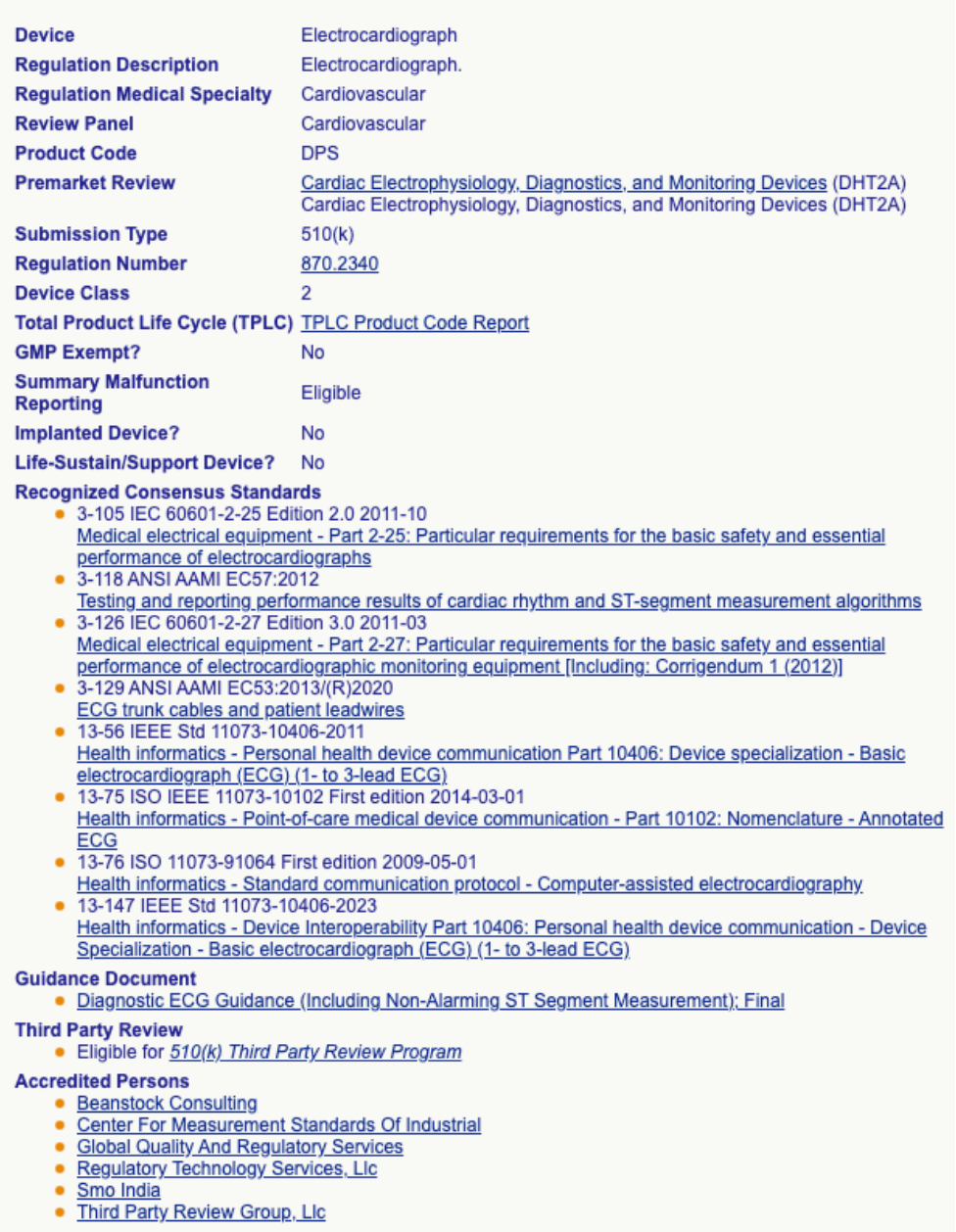
Example of what a product code looks like.
After finding your product code, you can go one step deeper here and find a predicate device for your medical device, but that's a topic I could cover in an entire blog post, and I will in the future.
Can’t find a good product code for your device? The plot thickens. Read on to find out what to do next in that case.
FDA Pathways to Market
I like to think that the FDA has four common paths to market that most people should be familiar with. They are:
- 510(k) exempt - Class I, low risk products and quick to market since no formal pre-market submission is required.
- 510(k) - Class II, medium risk products following a predicate device approach.
- De Novo - Novel, low-medium risk products for which there is no current predicate / product code that matches your product.
- PMA - Class III, high risk products requiring more scrutiny of review.
These different pathways are ordered from low to high complexity and time to market, with products going through a 510(k) exempt pathway taking only a few months to PMA products taking years.
Typically, the timing commitment is on account of the higher risk products and more complex pathways like De Novo and PMA typically requiring more clinical data which ultimately extends the development time for the device. FDA also sets longer review periods for these kinds of applications (6 months vs 3 months for 510(k)s)
If your product is very low risk, I recommend a few other, often lesser known, regulatory categories your device may fit into. These are general wellness and enforcement discretion.
General wellness products are those that promote a healthy lifestyle and aren’t considered under the purview of FDA regulations. FDA has a nice guidance on this and describes it in detail. These you can bring to market without any interaction with the FDA.
Enforcement discretion is a bit more convoluted. We see it most often with medical device software functions but it can also include other random product categories like infant formula. FDA use it as a way to ease regulations on lower risk products so manufacturers can have more freedom to get them to market quickly. It essentially is FDA saying “we are deciding not to regulate you guys now, but we might in the future and you better be ready.” We usually encourage folks to put together a minimal set of quality processes and technical documents if they go this route to avoid any issues if FDA lifts the enforcement discretion policy down the road and decides to regulate your product.
Talking to the FDA early (for free!)
In order to confirm your path to market, you and your team should definitely consider doing a Q-Submission / Pre-Submission. One of the best reasons why is because they're free!
Since it’s free, sending your extensive list to questions over to FDA tomorrow is the best plan of action right? No. Let me explain why.
Pre-submissions can be used to de-risk your future submission. It’s a way to get FDAs input on how you’re developing your device, your strategy, your testing plan, and more before you click the submit button on your application. It’s incredibly powerful and can save you serious time and headaches later on.
Here are the things people do wrong when submitting a pre-submission:
Asking questions FDA won’t answer in a pre-submission, like “what is my device classification?”
FDA has a guidance for pre-submissions and they specifically list what they cover in these meetings. They will not tell you what your device classification is and instead point you to a classification request or a 513(g). These aren’t required before you submit. FDA will however give you advice on if your predicate device or product code is correct which will give you your device classification quite plainly.
Not giving FDA enough information to answer their questions.
Asking about a clinical trial? Submit your clinical trial protocol. If you’re asking what biocompatibility testing is required for your device and don’t supply FDA with a detailed overview of your device materials, they can’t answer that for you. There is nothing worse than submitting a pre-submission only to find out 75 days later that FDA won’t answer half your questions cause they didn’t have enough information.
Asking FDA open ended questions on strategy instead of getting confirmation from them on your plan.
Get a plan together, iron out the details for your device and ask FDA if they agree with you. IF they don’t, they’ll give their reasons don’t worry. Don’t get me wrong, asking open ended questions can be fine. “Does FDA have any additional concerns about our usability testing?” for example is likely fine. However, asking FDA “do you want us to run a clinical trial?” is like asking a child if they want some candy. They’re of course going to say “that would be great!”
Raising ethical questions from FDA during the meeting or not taking FDAs advice in future pre-submissions.
A pre-submission is a chance for you to meet the FDA but more importantly a chance for FDA to also meet you. Don’t give them reason to question your integrity. Your committee that reviews your pre-submission may not be the exact same that does your eventual submission review but pre-submission information is attached to future submissions and can be referenced by reviewers. You don’t want to give FDA reason to suspect they need to dig even deeper into your application and product than they already plan to. By not taking their advice, you’re just setting yourself up for a difficult submission.
Pre-submissions take 60-75 days to complete so while they are free to submit, they do cost you time. It’s worth it to do the basics right and provide good info and well thought out questions so that that isn’t just 75 days wasted for you and your team without good feedback from the FDA at the end of it.
How a good regulatory strategy an enables you to move faster
A regulatory strategy is one of the first things we develop with our clients. I will say I have seen many regulatory strategies in my lifetime and they are not all built the same.
In general, I always say be wary of a regulatory expert who tells you “this is your only path to market with your product, take it or leave it.” There are always changes we can make to our claims, feature set, indications for use, testing strategy, etc. that can affect our path to market.
A good regulatory strategy lays out your requirements, how to meet them, and the time required to complete them. When we work with our clients we also spell out multiple alternative strategies they could follow with different benefits and risks.
This could be expanding or reducing feature sets, isolating regulated software features from non-medical ones, sequential submissions with increasing claims, and more. Taking into consideration your ideal product not only 6 months from now but 3 years from now is critical to a good strategy. This often has serious implications not only to how your initial regulatory clearance proceeds but how all subsequent product changes happen.
Having a good regulatory strategy lays this out cleanly and can optimize for what resources your business has in house. For example, have great connections with clinical sites? Maybe pursuing a clinical study yields the most efficient clinical performance data for our submission. No clinical connections but great data-sets? Maybe retrospective clinical validation makes the most sense. Lacking cybersecurity resources? Maybe scoping out the bluetooth connection for product version 1 and following up with a follow on 510(K) using your own product as a predicate is faster and gets you your market entry more quickly.
I always say, your business and customer needs should be considered first for the product. What is the point of getting a product through a hard fought regulatory journey if user adoption falls flat or the reimbursement code no longer applies.
Our approach to regulatory strategy marries these two, sometimes competing, factors to get a great product to market in the most expedient time frame. That is how great regulatory support works in action.
Is your submission already in motion with the FDA, and are you an ABHI member?
As part of our new partnership with ABHI, we’re opening 5 complimentary 30-minute FDA strategy sessions for companies considering the US market or already progressing through the FDA process.
These sessions will be led by Dr. Spencer Todd Founder & CEO of FormlyAI, - and (formerly at FDA) - and are designed to help you pressure-test your pathway, identify risks early, and clarify your next regulatory steps. Limited to 5 companies.
Not quite there yet? We've got something for you too.
This summer, we're running a webinar and newsletter series walking through the FDA pathway, built specifically for UK and European health tech companies expanding into the US market. If that's on your roadmap, sign up here and submit your questions. We'll shape our content to your issues.